
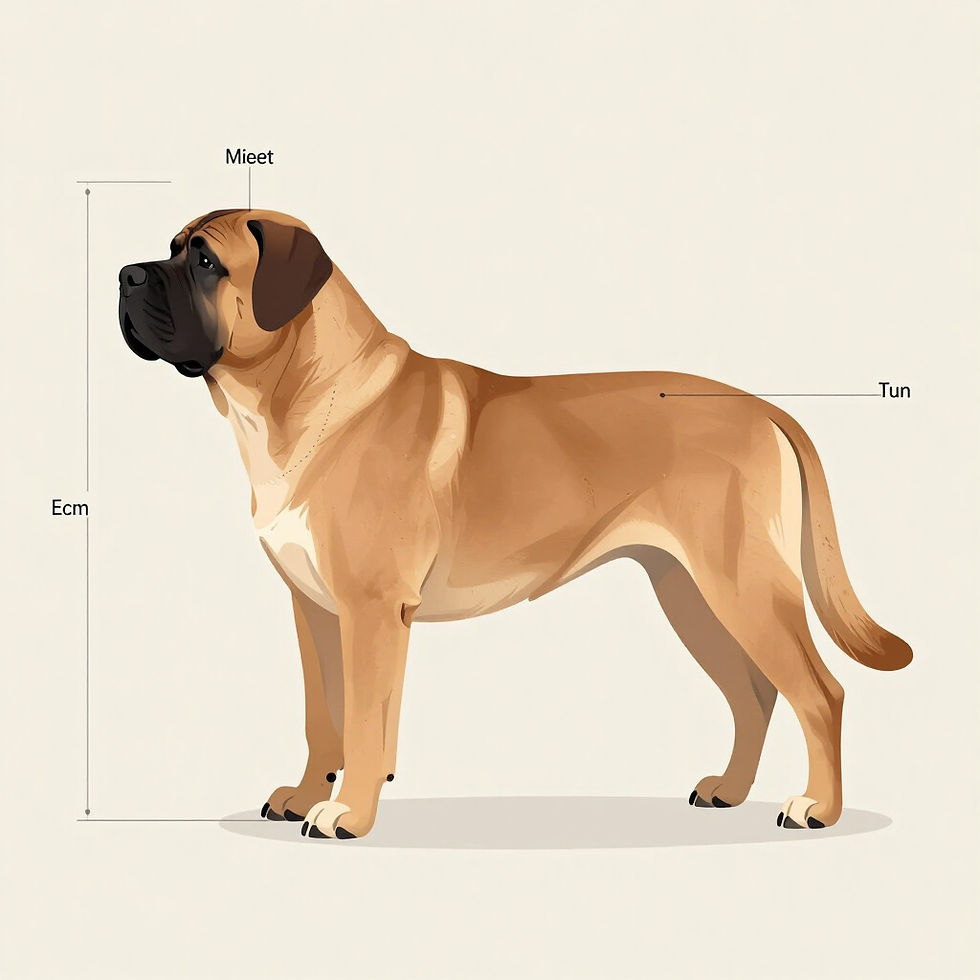
Proportions Diagram
General Appearance
The English Mastiff is a large, powerful, heavy-boned and strongly built mastiff, combining great size and substance with balance, soundness and dignity.
The body is broad, deep and muscular, with a large, square-looking head, powerful neck, wide chest and strong hindquarters. The overall impression should be one of immense strength, but size and weight must never come at the expense of health, movement or function.
The dog should be substantial without being excessively fat, cumbersome or exaggerated. It must remain capable of moving freely and comfortably and should stand naturally on strong, sound limbs.
Males should appear noticeably masculine and females feminine, while both retain the characteristic power and substance of the breed.
Above all, the English Mastiff should look like what it is — a huge, powerful, functional mastiff, not simply a heavy dog.

Historical Reference
History & Original Purpose
The English Mastiff is one of Britain’s oldest and most imposing mastiff breeds, developed from the large mastiff-type dogs that had existed in Britain for centuries.
These dogs were valued for their size, courage, strength and guarding ability. Historically, mastiff-type dogs were used to guard homes, estates and livestock and, during different periods, were also used for hunting large game, warfare and blood sports such as bull and bear baiting.
As society changed, so did the Mastiff. Its role moved away from fighting and dangerous pursuits and towards that of a guardian, companion and family dog.
The breed was severely reduced in numbers during the World Wars, particularly during the Second World War when feeding such enormous dogs became extremely difficult. Dedicated breeders in Britain, with help from surviving bloodlines overseas, rebuilt the population.
Today’s English Mastiff should retain the power, confidence and imposing presence of its ancestors, but in a stable, dependable family companion.
Its history explains its enormous size and natural guarding instinct — but modern breeding should preserve these characteristics without sacrificing health, soundness or function.

Head Construction
Head & Skull
The head is large, broad and powerful, forming one of the defining features of the English Mastiff. It should be impressive and substantial while remaining balanced with the enormous size and strength of the body.
The skull is broad between the ears and should appear square when viewed from the front. The forehead is relatively flat, with wrinkles becoming more noticeable when the dog is alert or interested.
The stop should be clearly defined without being excessively abrupt. Cheeks are strong and well developed, contributing to the broad, powerful appearance of the head.
The head should carry some characteristic loose skin and wrinkle, particularly across the forehead, but excessive skin, heavy folds or wrinkles that interfere with the eyes or general function are undesirable.
Dogs and bitches should retain appropriate sex characteristics — males generally carrying a larger, more powerful head, while females may be slightly more refined without becoming narrow or losing Mastiff type.
The head should convey strength and unmistakable Mastiff character — large and impressive, but never exaggerated at the expense of health or function.
OFFICIAL PUBLICATION
ENGLISH MASTIFF
Breed Standard

The Official Bullbreeds United Breed Standard for the English Mastiff.

Muzzle & Nose Diagram
Muzzle, Nose & Breathing
The muzzle is short, broad and deep, giving the English Mastiff its characteristic powerful expression. It should be square in appearance and remain broad from beneath the eyes towards the nose rather than becoming narrow or pointed.
The nose is large and broad with wide, open nostrils. Black pigmentation is preferred, particularly in keeping with the characteristic dark mask of the breed.
The muzzle should be substantial without being excessively shortened. Wrinkling may be present, but heavy folds must not obstruct the nostrils or interfere with normal breathing.
An English Mastiff should be able to breathe freely and quietly at rest. Pinched nostrils, obvious respiratory effort, persistent noisy breathing or excessive shortening of the muzzle should not be considered desirable breed characteristics.
Powerful head. Broad muzzle. Open nostrils. Free breathing.

Eye Set & Shape
Eyes
The eyes should be medium in size, set well apart and neither protruding nor excessively deep set, giving the Mastiff a calm, intelligent and attentive expression.
Eyes should be brown, with darker shades preferred, and should complement the characteristic dark mask of the breed.
The eyelids should fit the eye sufficiently well to protect it. Excessively loose or drooping eyelids, excessive visible haw, entropion, ectropion or any construction that leaves the eye vulnerable to irritation or injury is undesirable.
When looking forward, excessive visible white should not be present.
The expression should remain soft and dignified while still showing the confidence and awareness expected of a Mastiff.
Healthy, comfortable eyes must always be prioritised over exaggeration.

Ear Carriage Photo
Ears
The ears should be small in proportion to the size of the head, thin to the touch and set well apart at the highest points on the sides of the skull.
They should lie close to the cheeks when the dog is relaxed and contribute to the broad, square appearance of the head without appearing heavy or oversized.
The ears should be darker than the surrounding coat, forming part of the characteristic dark mask and expression of the English Mastiff.
Natural, correctly carried ears are essential to breed type. Ears that are excessively large, heavy, high or incorrectly carried should be considered undesirable.
The ears should complement the head — small, neat and unmistakably Mastiff.

Bite & Teeth
Mouth & Bite
The jaws should be broad, strong and powerful, in keeping with the size and substance of the head.
The bite may be level or slightly undershot, provided the lower teeth are not visible when the mouth is closed. An excessively undershot jaw or a bite that prevents the mouth from closing comfortably is undesirable.
Canine teeth should be strong, healthy and well separated, with the lower jaw remaining broad rather than narrow or pinched.
The lips should complete the characteristic square appearance of the muzzle. Some looseness is expected in the breed, but excessive lip or flews should not interfere with eating, drinking or normal function.
The mouth should close naturally and comfortably.
A powerful Mastiff jaw should remain functional — strength without unnecessary exaggeration.

Neck & Arch
Neck
The neck should be powerful, muscular and moderately arched, supporting the large head with ease and flowing smoothly into strong, well-laid shoulders.
It should be broad and substantial, in proportion with the overall size and strength of the dog, without appearing excessively short or restricting normal movement.
Some loose skin beneath the neck is characteristic of the breed, but excessive folds or heavy dewlap should not be encouraged.
The neck must allow the dog to carry and move its head freely and breathe comfortably, maintaining the balance and powerful outline expected of an English Mastiff.
Strong, broad and functional — never exaggerated.

Proportions & Size
Size & Proportions
The English Mastiff is a giant breed, but overall balance, soundness and correct construction are more important than size or weight alone.
Height at the withers:
-
Males: ideally 30 inches (76 cm) or above
-
Females: ideally 27.5 inches (70 cm) or above
There should be no reward for excessive weight simply for the sake of being heavier. A Mastiff should carry enough substance, bone and muscle to clearly represent the breed while remaining fit and capable of normal movement.
The body should be slightly longer than the height at the withers, creating a powerful rectangular outline rather than appearing excessively long, short-legged or square.
Depth of body is important, with the chest extending well down between the forelegs. Bone should be substantial throughout and in proportion to the dog's frame.
Males are generally larger and heavier than females, with clear sexual distinction expected.
Correct proportion creates the Mastiff — size alone does not.

Body Construction
Body & Chest
The body should be broad, deep, powerful and muscular, with substantial ribbing and plenty of room through the chest without appearing excessively heavy or cumbersome.
The chest should be wide and deep, extending well down between the forelegs. The ribs should be well sprung and carried back, providing a strong, capacious body rather than a narrow or slab-sided appearance.
The back should be broad, strong and well supported, with a powerful loin connecting smoothly to the hindquarters. The topline should remain firm and balanced when standing and moving.
A visible tuck-up is not expected to be dramatic in such a substantial breed, but the dog should still show body shape and condition rather than simply carrying excess weight.
The overall body should give the impression of enormous strength while remaining properly supported by the dog's frame and limbs.
Deep, broad and powerful — substance should come from correct construction, bone and muscle, not obesity.