
BULLMASTIFF BREED STANDARD


Origins
The Bullmastiff was developed in 19th-century Britain as the Gamekeeper’s Night Dog, created from Mastiff and Bulldog ancestry to protect large estates and game preserves from poachers.
The gamekeeper required a dog with the strength and courage to confront a man, but also the speed, athletic ability and determination to pursue him through the estate at night.
The Bullmastiff was expected to locate and pursue a poacher, bring him to the ground and hold him until the gamekeeper arrived.
This demanding working role shaped the Bullmastiff into the powerful, courageous and physically capable guardian breed recognised today.
General Appearance
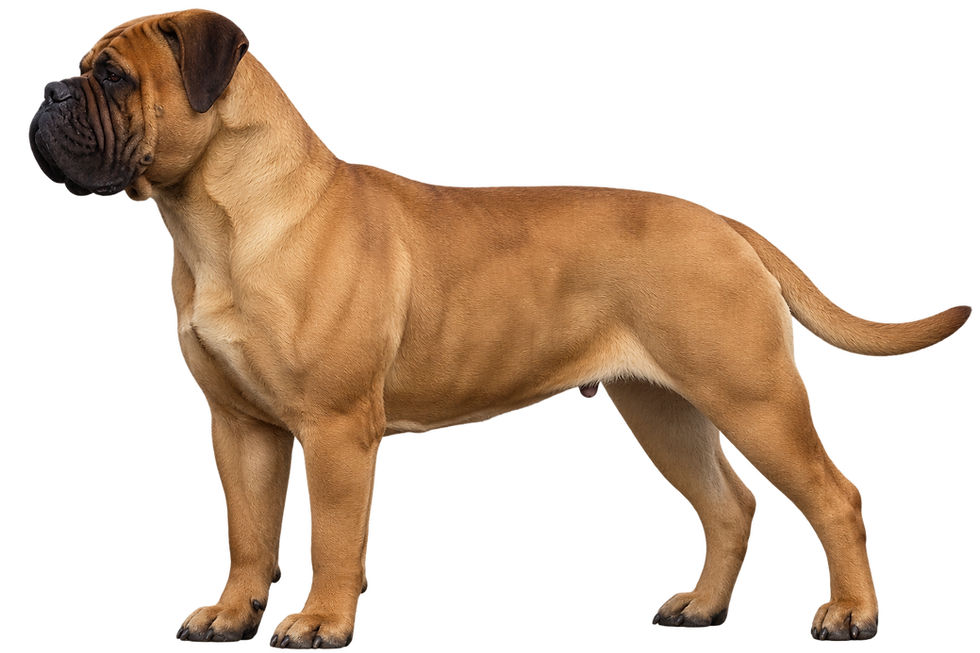
The Bullmastiff is a powerful, substantial and well-balanced dog, combining great strength and bone with athletic ability and sound movement.
The body should be broad, muscular and strongly constructed, with a large, powerful head and an imposing overall appearance. Despite its size and substance, the Bullmastiff should never appear cumbersome, excessively heavy or unable to move freely.
The overall impression should be of a confident, physically capable working mastiff possessing the strength, speed and agility required for its original role as the Gamekeeper’s Night Dog.
Power and substance should come from correct structure, bone and muscle rather than excessive body weight or exaggeration.


Head & Muzzle
The head should be large, broad and powerful, appearing square when viewed from any angle and remaining proportionate to the overall size and substance of the dog.
The skull should be broad and deep, with a well-defined stop and strong, developed cheeks. Wrinkling may appear when the dog is alert but should not be excessive.
The muzzle should be broad, deep and powerful, approximately one third of the overall length of the head. It should remain wide through to the nose and should never appear narrow, weak or excessively shortened.
The jaws should be strong and capable, reflecting the Bullmastiff’s original working purpose. Excessive exaggeration of the head or muzzle that compromises breathing, vision or normal function is undesirable.
Size & Proportions
The Bullmastiff is a large, powerful and substantial breed.
Males should measure approximately 25–27 inches (64–69 cm) at the withers, with females approximately 24–26 inches (61–66 cm).
The body should be strong, broad and well proportioned, with substantial bone and well-developed muscle. The dog should appear powerful without becoming excessively heavy or cumbersome.
Overall balance, sound construction and physical condition are more important than excessive size or weight. The Bullmastiff should retain the proportions and athletic ability necessary to move with strength, speed and purpose.
Nose & Breathing
The nose should be broad and well developed, with large, open nostrils allowing unrestricted airflow. The nose should be black.
The Bullmastiff should breathe freely, quietly and effortlessly at rest. The muzzle should provide sufficient length and width to allow normal respiratory function.
Pinched or excessively narrow nostrils, restricted airflow, or persistent noisy or laboured breathing at rest are undesirable.
Head size and substance should never be achieved at the expense of healthy breathing or the dog’s ability to exercise freely.
Eyes
The eyes should be dark or hazel, medium in size and set well apart, giving a confident, intelligent and alert expression.
They should be proportionate to the head and neither excessively prominent nor deeply sunken.
The eyes should be clear and healthy, with surrounding skin and wrinkles never interfering with normal vision.
Ears
The ears should be small to medium in size, V-shaped and set high and wide, contributing to the broad, square appearance of the head.
They should fold naturally and lie close to the cheeks when relaxed, becoming more alert in carriage when the dog is attentive.
The ears should remain proportionate to the head. Excessively large, heavy or poorly set ears are undesirable.
Body & Condition

The body should be powerful, broad and strongly muscled, with substantial bone, a deep wide chest and well-sprung ribs.
The back should be strong and well supported, with the overall body appearing balanced, solid and capable of powerful movement.
The Bullmastiff should be maintained in fit, muscular condition with a visible waist and appropriate abdominal tuck. Its impressive size and substance should come from bone, structure and muscle rather than excess body fat.
An overweight, excessively bulky or poorly conditioned Bullmastiff that has lost the athletic ability required of the breed is undesirable.
Front Construction
Viewed from the front, the Bullmastiff should appear broad, powerful and well balanced, with good width through the chest and shoulders.
The forelegs should be straight, strong and substantially boned, positioned naturally beneath the body and supporting the dog’s weight evenly.
The shoulders should be powerful and muscular, allowing free forward movement. The chest should be broad and deep without becoming excessively wide or restricting the natural movement of the forelegs.
The overall front should demonstrate strength, stability and sound working construction.


Feet
The feet should be strong, compact and well formed, with rounded, well-arched toes and firm pads.
Feet should point naturally forward and provide a strong, stable base for the dog’s substantial frame.
Weak, flat or excessively splayed feet, or feet turning noticeably inward or outward, are undesirable.
Rear Construction
The rear should be strong, broad and powerfully muscled, with well-developed thighs and balanced angulation. The hind legs should be substantially boned and positioned naturally beneath the body, with strong hocks providing stability and powerful forward drive. Viewed from behind, the hind legs should remain balanced and parallel during movement. Weak or narrow hindquarters, poor muscle development, excessive straightness or over-angulation are undesirable.

Movement & Athletic Ability
Movement should be powerful, balanced and purposeful, with good reach from the front and strong drive from the rear.
Despite its substantial size, heavy bone and powerful build, the Bullmastiff should remain athletic, agile and capable of sustained physical activity.
This ability is fundamental to the breed’s history as the Gamekeeper’s Night Dog. The Bullmastiff was required to move quietly across large estates, pursue a fleeing poacher, bring him to the ground and hold him until the gamekeeper arrived.
A correctly constructed Bullmastiff should therefore possess strength, speed, stamina and agility, and be capable of running, jumping and exercising freely.
Excessive size, weight or exaggeration that causes cumbersome, laboured or restricted movement is undesirable.
Tail
The tail should be strong, set high and taper gradually towards the tip. It may be carried straight or with a slight curve and should reach approximately to the hock. The tail should be naturally formed, freely movable and proportionate to the dog, contributing to balance during movement. Tightly curled, kinked, deformed or excessively short tails are undesirable.
Coat
The coat should be short, dense and close-fitting to the body, providing natural protection without hiding the dog’s muscular outline. The coat should appear clean, healthy and naturally glossy, reflecting good overall condition. Long, woolly, sparse or heavily feathered coats are undesirable.
Colour
Accepted colours are fawn, red or brindle in any shade.
The muzzle should carry a black mask, extending naturally around the muzzle and towards the eyes, with the ears generally darker in colour.
A small amount of white on the chest may be accepted, but extensive white markings are undesirable.
No accepted shade should be preferred over another. Colour should remain secondary to correct type, structure, health, temperament and physical ability.
Temperament
The Bullmastiff should be confident, courageous, loyal and dependable, forming a strong bond with its family.
Naturally watchful and protective, the breed should possess a strong guarding instinct and the confidence to stand its ground when necessary, without displaying unnecessary aggression.
The ideal Bullmastiff is calm and steady within the home while remaining alert, powerful and capable when required.
Early socialisation, clear boundaries and consistent training are essential due to the breed’s size, strength and natural guarding instincts.
Excessive nervousness, instability or unprovoked aggression are undesirable.